On the bourse where poems are traded
One must always maintain a hedge,
Some contrarian opinion to mold plain-speaking into nonsense
And turn gibberish to perfect sense—
The empty room must be jimmied open, light let in.
There’s nothing intrinsic here, just because
The prices multiply like corn or sorghum
—The value is the debt that’s taken on:
The obsequious doff of a cap as comment;
The memory recalled of paneled rooms in fall where words were
Cotton candy, pink and sticky and opiative sweet;
The gift of a gloss like a kiss or a candle on a long drafty night.
All these things become like postcards from your own home town,
They all have measured weights in precious metal backing them
And are saved up like Andorran stamps, to be redeemed.
Consciousness demands an equal and opposite consciousness
But performance is for the shareholder,
There’s no product, or customer, or even worker any more.
It’s pay to play, whether you rely on the fly-by-night offset
lithographer to the right
Or if you manage to whisper in the ears of the big boys and their
infinite debt
Portioned out equally like God’s mustard seeds to every student
But unlike God with an agenda to narcissize and abusivate
As they themselves were narcissed and abusized
All the way up that wobbly ladder to be downsized.
You have to hear them workshop talk and theorize
With their latest autographed autobiography ensconced in your wrist
Before you can ask them, in the softest tones,
How does one go about ... getting published?
Or maybe the trade takes place after hours,
In some dim coffee-kvetching club,
Where everyone shouts their POV
To gain the attention of the fabled silent hipster in the back
With his lavender Corvette and organic cigarettes
Who would in theory give up his pretense of a life
To follow you around, buy you a Skyy, admire your every
Breathing sound as an exhalation of the Great.
It’s only business, there’s nothing personal here,
They thank you for sharing at the door
After they collect your fare
(Compensation, like freedom, is never free).
How blessed all this is, though, to be nothing,
Unlike these ivy buildings or those instruments of chrome
That appear to hold a value, someone giving what they own for them
of worth,
For they too fall to nothing, bereft in every bubble-busted town
From Portland to North Platte to Off-White Plains…
It’s now a trading floor for children, where laughter earns a sourball
Or a drawering a gold star; they were born underwater
But still their infinite value is allowed
To ask for more, to make everyone laugh at how stupid you are,
To brag that their rhymes are doper than Dr. Seuss,
To make mistake after mistake with innocent insouciance,
Ask for some common coin in return.
And whatever we ask for drops, mysteriously
Without us ever really knowing it.
Wednesday, May 30, 2012
Tuesday, May 29, 2012
Paying the Universe Back
A meditation on this
No rumble. No wind. No ripples.
Now it is official:
The circle is only as wide
As my antenna.
Still I have this trouble
Conceiving it as greater—
Watching a baby's smile
Over fame that changes the world.
What recognition of myself
Is not more needed by the one?
What other gift is not a gift
Returned?
What else can we give
Except our stillness?
How else can we prove
That we are real?
No rumble. No wind. No ripples.
Now it is official:
The circle is only as wide
As my antenna.
Still I have this trouble
Conceiving it as greater—
Watching a baby's smile
Over fame that changes the world.
What recognition of myself
Is not more needed by the one?
What other gift is not a gift
Returned?
What else can we give
Except our stillness?
How else can we prove
That we are real?

Monday, May 28, 2012
Stevens Textplication 18: Depression Before Spring

Poems tend to be inappropriate venues for lover’s quarrels. The surface is too transparent, the levels underneath are too obscure. “Depression Before Spring” from 1918 broaches this topic with lightness and joviality, but still it captures the sadness of separate worlds. Here is the poem:
The cock crows
But no queen rises.
The hair of my blonde
Is dazzling,
As the spittle of cows
Threading the wind.
Ho! Ho!
But ki-ki-ri-ki
Brings no rou-cou,
No rou-cou-cou.
But no queen comesIn Pennsylvania, where Stevens came from, they say there are four seasons:
In slipper green.
- Winter,
- Still Winter,
- Hunting, and
- Construction.
Something of this sense comes through here, the frustration at the lack of doves and the fringe “slippers” of short green grass that signal spring. The roosters are calling but the spring, personified as a female queen, refuses to cooperate.
That level of meaning – appropriately poetic – works very nicely with the more explicit meaning between the speaker and the unnamed blonde "queen." The first stanza sets the tone with cock –prototypical male – aroused but failing to arouse the queen – prototypical female. This is a familiar early morning event in most bedrooms, with the ironic implication that upon the rooster’s announcement of morning one should “rise and (see next stanza) shine.” At a further layer, the cock is doing the speaking (“crow”), in an aggressive way, but the queen does not “rise” to the bait, or challenge.
The second stanza seems to affect an abrupt shift, a random and strange comparison between blond hair and cow spit. If one views this as a continuation of the previous stanza, however, it makes sense: the woman still asleep in the bed with the sunlight bearing down on her hair appears unpleasant, or at least the man who is trying to rouse her would offer such a comparison to get her “goat.”
The third stanza, “Ho! Ho!” thus becomes a triumphant gotcha interjection, the perfect metaphor of gamesmanship.
But, alas, this doesn’t do any good either. The sound of one (ki-ki-ri-ki) brings no response (rou-cou) from the other. A friend from Slovenia once asked me what roosters sound like in English. I replied, sheepishly, “cock-a-doodle doo.” He said “you know what they sound like in Slovenia? Ri-ki-ri-ki-ri-ki!” and he proceeded to laugh uncontrollably. I think what Stevens is getting at here is a better mimicking of what a rooster actually sounds like than what English customarily permits. The “rou-cou” similarly, is the sound a mourning dove makes, which enlongates into three syllables to mimic rococo, a playful but ornate Late Baroque style of art that (according to Wikipedia) “made strong usage of creamy, pastel-like colours, asymmetrical designs, curves and gold.” This is a nice trick: the supposed sadness of the dove merging into a luscious and awesome beauty, all of it suggesting that, for whatever reason, the female will not come out to play, depriving the speaker of her beauty and sadness. For all the pain of arguing, the alternative to the back and forth is silence. This strutting cock has met his match.
The concluding stanza ends with no queen, no “slipper green.” There are nuances of a rebirth, awakening, even the creation of life deferred, hence the depression. There’s also a touch of Cinderella and her slipper; the prince has been chasing an imaginary thing, and must confront the real. As Stevens wrote: “"Perhaps, it is best, too, that one should have only glimpses of reality - and get the rest from the fairy-tales, from pictures, and music, and books"* The queen is more there for being absent.
* quoted from George Lensing, Wallace Stevens: A Poets Growth, p. 64.
Sunday, May 27, 2012
Lyric: Last Diner
Another episode in the series
Down the mountain in late May / grass as high as a cat
Factories from the fifties / trees grown out of their stacks
There were jokes in the nightclubs / where these old trailers stand
Now the pines in the forest / give the cues to the band
Up ahead there’s a restaurant / smoked eel on the grill
A blue plate in the heyday / they still eat in here still
But they don’t talk to strangers / they just stare into space
Ancient songs on the jukebox / I saw some horses race
This is the last diner ‘til the border
It’s the last best hope / for the highest slope
Mark up your map and push it to the floor where
Every meal is free / with the scenery
In the neighboring county / they caught a lucky roll
Signed the tribe to a contract / opened up a casino
Here they just play their numbers / it’s a numbers game
And the cookie says zero / all that’s left is the name
They all looked at me closely / from a terrible woe
As if I was some producer / for a reality show
But they soon knew I only / came to screw with them too
A coke came not a malted / I can’t tell anyone what to do
This is the last diner ‘til the border
It’s the last best hope / for the interlope
Make the new old and shake off the road torpor
Every meal is free / on the company
People eating garbage / cleaning off their plate
People only smiling / at the worse off with hate
I don’t know how to help them / I am one of them too
I broke every rule to get my share / and now there’s nothing I can do
I paid in cash and I walked out / to a beautiful haze
Wanted only to get back / to my old familiar maze
Where they still have the horses / for the harness race
Thought they ran in heaven / not this broken place
This is the last diner ‘til the border
It’s the last best hope / it’s the dopest dope
Ring up your prayers and find them made to order
Every meal is free / for eternity
Here's last week's lyric done up as a song (thanks for the help, Robert)
World of Limes
Down the mountain in late May / grass as high as a cat
Factories from the fifties / trees grown out of their stacks
There were jokes in the nightclubs / where these old trailers stand
Now the pines in the forest / give the cues to the band
Up ahead there’s a restaurant / smoked eel on the grill
A blue plate in the heyday / they still eat in here still
But they don’t talk to strangers / they just stare into space
Ancient songs on the jukebox / I saw some horses race
This is the last diner ‘til the border
It’s the last best hope / for the highest slope
Mark up your map and push it to the floor where
Every meal is free / with the scenery
In the neighboring county / they caught a lucky roll
Signed the tribe to a contract / opened up a casino
Here they just play their numbers / it’s a numbers game
And the cookie says zero / all that’s left is the name
They all looked at me closely / from a terrible woe
As if I was some producer / for a reality show
But they soon knew I only / came to screw with them too
A coke came not a malted / I can’t tell anyone what to do
This is the last diner ‘til the border
It’s the last best hope / for the interlope
Make the new old and shake off the road torpor
Every meal is free / on the company
People eating garbage / cleaning off their plate
People only smiling / at the worse off with hate
I don’t know how to help them / I am one of them too
I broke every rule to get my share / and now there’s nothing I can do
I paid in cash and I walked out / to a beautiful haze
Wanted only to get back / to my old familiar maze
Where they still have the horses / for the harness race
Thought they ran in heaven / not this broken place
This is the last diner ‘til the border
It’s the last best hope / it’s the dopest dope
Ring up your prayers and find them made to order
Every meal is free / for eternity
Here's last week's lyric done up as a song (thanks for the help, Robert)
World of Limes
Saturday, May 26, 2012
Near Trout Town USA
Roscoe, New York
The kind of brook
that makes you feel
the moving world
beneath your feet
The kind of brook
that turns to phosphorescent blue
The kind of brook
you are the tree
that reaches over
fingers dipping in quicksilver
The kind of brook
to lose and reveal
its skin and soul
continuously
The kind of brook
where branches hang
but don't touch down
The kind of brook
that when you acknowledge
its presence
welcomes your own
The kind of brook
whose oak trees heal the mind
whose cool sand banks
hold massive grappling skirts
of airborne pine
The kind of brook
whose islands of wet grass
shine a million miles away
The kind of brook
where squealing birds and slurping banks
and snarling currents sound
like total silence
The kind of brook
that overlooks white-coated rocks
moss blossoming in cracks
rhododendron behind which
words need not exist
The kind of brook
whose calligraphy of limbs
along the green shore
decode the truth our rigid
rapids never catch
The kind of brook
that turns you into stillness
makes you long to be of service
waiting on words
Friday, May 25, 2012
North of Suffren
I. Graduation Feathers
They were waiting for me,
the Catskills,
with greetings of cattails
and wild mountain flowers,
the most complete
harmony of trees
prepared for my arrival.
"Sell your ephemera"
the peeling billboard said
as cottonwood down floated
along the road to Damascus
amid the emerald and evergreen
of irridescent valleys,
molten lavender hillsides,
slippery cliffs,
rough-as-cloudwool peaks.
The families of prominence
each are taking turns
in mottled sunshine
for my view.
II. Framed by Goldenrod
Fishermen like flies
inside the river fishing
III. Beyond Hungry Hollow
The pink barns of apple country,
Eskew's Mulches,
Kellystone and Jellystone Parks,
Old Brutus Historical Society,
You know you're in the country
When you see that 7Up sign.
They were waiting for me,
the Catskills,
with greetings of cattails
and wild mountain flowers,
the most complete
harmony of trees
prepared for my arrival.
"Sell your ephemera"
the peeling billboard said
as cottonwood down floated
along the road to Damascus
amid the emerald and evergreen
of irridescent valleys,
molten lavender hillsides,
slippery cliffs,
rough-as-cloudwool peaks.
The families of prominence
each are taking turns
in mottled sunshine
for my view.
II. Framed by Goldenrod
Fishermen like flies
inside the river fishing
III. Beyond Hungry Hollow
The pink barns of apple country,
Eskew's Mulches,
Kellystone and Jellystone Parks,
Old Brutus Historical Society,
You know you're in the country
When you see that 7Up sign.
Thursday, May 24, 2012
Last Night
A North Korean microvirologist
and an East German software security specialist
were drinking barley wine in a Northern Ireland bar
in Rochester New York
arguing whether white hots
should go on a garbageplate.
Do you see how crazy my life is?
and an East German software security specialist
were drinking barley wine in a Northern Ireland bar
in Rochester New York
arguing whether white hots
should go on a garbageplate.
Do you see how crazy my life is?
Wednesday, May 23, 2012
Meanwhile in the Material World
May is the month in Phoenician Britain
When they worship Nimrod,
The Baal of Beltane,
With bagpipes from Morocco,
The original serpent king
With his hybrid test tube babies
And his two-faced forked tongue
That all our Gods came from,
On a throne of horns with his virgin bride
Who wanted just to kill him,
Mammi at his side,
Known as Isis, Ishtar, Astarte, Athena, Diana, Mary,
“the one face hidden by the many masks,”
Like the Hebrew initiates of the Egyptian mystery school
Who were turned by Babylon’s dragons into Jews
To transmute Zion’s sun and Moses’ muse
And told to follow rules like wishing harm on all the Gentiles
By high priests in psilocybin mushroom hats;
Or Jesus, whose real name was Arrius Piso,
The murderer of Nero,
Who made believe that he was Horus
While the Essenes washed their hands
And the Nazarenes joined the Zealots,
Wrote a brand new book for rebel Jews
That instead remade the moldy Empire Holy,
With new terms of surrender
And a cannibalistic eucharist.
In Manhattan’s pentagrams of darkness
Draculas with dragon wings drift through magick black,
The stones that healed in ancient time now sexualized to shame,
Mage mascara makes Egyptian eyes
On hierophant hermaphrodites
Who walk below the gold of pharaoh tombs,
Its columns, discs and obelisks
As if the slaves once trapped there
Are no more, as if the scientists of sound
Who imagined Saint Patrick’s Cathedral,
Where Jehovah and Lucifer are the same being,
The one unquestioned good in a hell of endless threat,
Have not evolved to deeper sine waves
In vocoder voices synthesized
To synthetic primal rhythm.
There’s fear as far
As the mind can perceive, the rows of empty storefronts
Are filled with things none can afford,
But they drive their broken hearts to gain their share
Of what is visible, material, because they’ll never be
One of the invisible, the royal reptiles
Who need blood, not flashy and disposable jewels.
The gargoyles watch with wings perched
On every public building that reminds us to obey.
In the caves new Mohammeds take dictation
To keep those taking power from the saved.
Above them all the black Moloch cathedrals,
The stone temples of pyramid money
That vie with passing serpents in the sky.
Every good girl must get raped sometime,
Every boy must be arrested with his pants pulled down,
Every vodka must be top-shelf for the chemistry to gel.
Last call for oblivion, for the soul too willingly bartered
For a kind look or the right word, or an edge when
Chasing pussy down the catacombs of sin.
“Are you responsible?
“Mistakes are always made.”
“Are you reliable?”
“We people have our failings.”
“Are you professional?”
“Or do you take things personal?”
“Are you worthy of my trust?”
“You begging child who was born worthless.”
She finds the moment to unleash
Her reticent resistance.
He takes the opportunity
To squeeze between her drink.
There are no words
For what he is,
And she could never say,
So the play the roles of heel and femme fatale
As the poison that they drink turns into words,
Turns into shame, and no ones sees the seven stars
That glow above her head, more radiant than
The crown of thorns adorning Lady Liberty.
He plays the one song of his life over and over
While mold grows on the hotel wall
And every person there wants to abduct him
And the only producers who can help him here
Are dealers, with white gloves and woolen aprons.
The life he lived was not worth living,
How the people thought the same and dreamed
Of nothing, but surviving
While the picturehouse played every possibility
In his head, in every home at ten o’clock
The giant blue-eyed screen
The live feed near from where he lives now:
The Masonic Temple of Druids with their wands of Hollywood
Performing the same trick
As the Wiccans, Freemasons, Mormons:
The rings and secret oaths, the beatings
And exhibited slaves, while in other rooms
They sacrifice some children for the adrenaline
At the moment of their death
And no Satan dogs from Sirius
Will ever detect the bodies under bodies
In their cemeteries, as dreamers come each day
To find the prize that they are missing,
The stardom and the love that has been stripped
Away already, and will never be returned.
The cities underground, to Lancaster and Reno,
Will make of them what everyone desires:
Programmed slaves who always win the best awards.
The obelisk and dome at zero Greenwich time
At Canary Wharf down 1206 from Isle of Dogs
Like Angkor Wat is pointed to the Halls of Draco.
It’s best that I should make my own copper astrolabe
From now on.
Still I have such sadness
For all the lizard people
Who see with eyes deranged
To patterns, colors without form,
Their paper skin no home for love or warmth,
Just the humorless business of
Setting traps for the stupid, the doubting, the lost
With a web that must stay spinning
And the planet spinning nearer to the central sun
That wakes us all up from the deepest sleep
To brush away the ways they tried
To save us from ourselves.
We needed all that sorrow
To be laughing, laughing now.
When they worship Nimrod,
The Baal of Beltane,
With bagpipes from Morocco,
The original serpent king
With his hybrid test tube babies
And his two-faced forked tongue
That all our Gods came from,
On a throne of horns with his virgin bride
Who wanted just to kill him,
Mammi at his side,
Known as Isis, Ishtar, Astarte, Athena, Diana, Mary,
“the one face hidden by the many masks,”
Like the Hebrew initiates of the Egyptian mystery school
Who were turned by Babylon’s dragons into Jews
To transmute Zion’s sun and Moses’ muse
And told to follow rules like wishing harm on all the Gentiles
By high priests in psilocybin mushroom hats;
Or Jesus, whose real name was Arrius Piso,
The murderer of Nero,
Who made believe that he was Horus
While the Essenes washed their hands
And the Nazarenes joined the Zealots,
Wrote a brand new book for rebel Jews
That instead remade the moldy Empire Holy,
With new terms of surrender
And a cannibalistic eucharist.
In Manhattan’s pentagrams of darkness
Draculas with dragon wings drift through magick black,
The stones that healed in ancient time now sexualized to shame,
Mage mascara makes Egyptian eyes
On hierophant hermaphrodites
Who walk below the gold of pharaoh tombs,
Its columns, discs and obelisks
As if the slaves once trapped there
Are no more, as if the scientists of sound
Who imagined Saint Patrick’s Cathedral,
Where Jehovah and Lucifer are the same being,
The one unquestioned good in a hell of endless threat,
Have not evolved to deeper sine waves
In vocoder voices synthesized
To synthetic primal rhythm.
There’s fear as far
As the mind can perceive, the rows of empty storefronts
Are filled with things none can afford,
But they drive their broken hearts to gain their share
Of what is visible, material, because they’ll never be
One of the invisible, the royal reptiles
Who need blood, not flashy and disposable jewels.
The gargoyles watch with wings perched
On every public building that reminds us to obey.
In the caves new Mohammeds take dictation
To keep those taking power from the saved.
Above them all the black Moloch cathedrals,
The stone temples of pyramid money
That vie with passing serpents in the sky.
Every good girl must get raped sometime,
Every boy must be arrested with his pants pulled down,
Every vodka must be top-shelf for the chemistry to gel.
Last call for oblivion, for the soul too willingly bartered
For a kind look or the right word, or an edge when
Chasing pussy down the catacombs of sin.
“Are you responsible?
“Mistakes are always made.”
“Are you reliable?”
“We people have our failings.”
“Are you professional?”
“Or do you take things personal?”
“Are you worthy of my trust?”
“You begging child who was born worthless.”
She finds the moment to unleash
Her reticent resistance.
He takes the opportunity
To squeeze between her drink.
There are no words
For what he is,
And she could never say,
So the play the roles of heel and femme fatale
As the poison that they drink turns into words,
Turns into shame, and no ones sees the seven stars
That glow above her head, more radiant than
The crown of thorns adorning Lady Liberty.
He plays the one song of his life over and over
While mold grows on the hotel wall
And every person there wants to abduct him
And the only producers who can help him here
Are dealers, with white gloves and woolen aprons.
The life he lived was not worth living,
How the people thought the same and dreamed
Of nothing, but surviving
While the picturehouse played every possibility
In his head, in every home at ten o’clock
The giant blue-eyed screen
The live feed near from where he lives now:
The Masonic Temple of Druids with their wands of Hollywood
Performing the same trick
As the Wiccans, Freemasons, Mormons:
The rings and secret oaths, the beatings
And exhibited slaves, while in other rooms
They sacrifice some children for the adrenaline
At the moment of their death
And no Satan dogs from Sirius
Will ever detect the bodies under bodies
In their cemeteries, as dreamers come each day
To find the prize that they are missing,
The stardom and the love that has been stripped
Away already, and will never be returned.
The cities underground, to Lancaster and Reno,
Will make of them what everyone desires:
Programmed slaves who always win the best awards.
The obelisk and dome at zero Greenwich time
At Canary Wharf down 1206 from Isle of Dogs
Like Angkor Wat is pointed to the Halls of Draco.
It’s best that I should make my own copper astrolabe
From now on.
Still I have such sadness
For all the lizard people
Who see with eyes deranged
To patterns, colors without form,
Their paper skin no home for love or warmth,
Just the humorless business of
Setting traps for the stupid, the doubting, the lost
With a web that must stay spinning
And the planet spinning nearer to the central sun
That wakes us all up from the deepest sleep
To brush away the ways they tried
To save us from ourselves.
We needed all that sorrow
To be laughing, laughing now.
Tuesday, May 22, 2012
Something's Different
The trees have now turned blue
returned to their original color;
you're free to be who you are.
The sky is violet now
you see its higher frequency;
a larger field from which to capture dreams.
The water rises burgundy
from caverns in the soil;
your beauty now is fearless
You have to jump right in.
returned to their original color;
you're free to be who you are.
The sky is violet now
you see its higher frequency;
a larger field from which to capture dreams.
The water rises burgundy
from caverns in the soil;
your beauty now is fearless
You have to jump right in.
Monday, May 21, 2012
One Day in Haiku
“The aim of haiku is to live twenty four hours a day, that is, to put meaning into every moment, a meaning that may be intense or diffuse, but never ceases.” – R.H. Blythe
I’ve woken all week from this Hindu Professor
Lecturing me on invisible gaps in space
That hold everything together and keep us apart
The blue detergent from the dark cupboard corner
When released floods with pent-up sudsy life
I didn’t follow directions
Trees are the image
Opera the sound
I am the eyes and the ears
An old friend on the phone
“Splendid, that’s simply splendid”
After: “that poor, poor girl”
The sound of water
Swirling over mossy rocks
A camera clicks
“Did you get a good photo?”
“Do not concern yourself with my picture-taking
Go back to your red notepad.”
At the still pond
A leaf tries to get in the picture
A bullfrog tries to get in the poem
Crackling leaves
As from raindrops falling
Above us golden branches, blue sky
Kodak moments
No camera
No more Kodak
Wind through the trees like a rushing stream
But there’s only the stone walls that are a way of life here
At the real stream dogs want to pee
Bouquets in thick black mud
Elephant ears, skunk cabbage, tall yellow iris,
A powder-blue dragonfly with four giant wings
Our quiet walk
Disturbed by a sudden, simultaneous “ah”
Dirt and rock above our heads from an overturned tree
A tree and a rock in the same spot
Have been fighting it out for years
The tree with its chokehold seems to be winning
Poorhouse Brook
Down Frogtown Road
In water turned to filthy-rich wine New Canaan
At the top of the hill beyond the desolate forest
Brand-new mansions all in antique taupe
Every one is deserted, For Sale by Broker
Flags and balloons surround the deli
The doors are flung open wide
The proprietor says hi and smiles, but no food
An actual green yellow red
Traffic light stands in someone’s front yard
I wonder if they turn it on at Christmas
The music is too furious
We wait it out in the driveway
"Cello Concerto" by Camille Saint-Saëns
Pulling roots, dragging water, digging holes, planting flowers
Exhausted afterwards
Like after a fuck
Reading, reading, poetry everywhere
But to catch it I must walk a million miles
Hey that’s me up ahead, reading
The house is now still
Despite the churning of my brain
My clothes spin in the washing machine
A call: they’re drinking urine in LA now
I fear it may now be too late for my idea
Trapped Amazonian Oxygen in canisters
Tony comes to fix the fence
Asks me about the future of the Euro
Says he misses Michelangelo’s face on the Lire
“Times were better when they were worse,
You know, that’s what they say in Sicily
But to them 100 years is in their back pocket.”
Tiny turds in our house we follow as breadcrumbs
To a chipmunk hanging from the window shade
That explains all the funny business in this house
It takes a broom, quick
Reflexes and a village
To coax a chipmunk outdoors
She remembers every number on her old address
In Delaware Ohio
But doesn’t know if Harding or Hayes was born there
Away from his people, Steven Tyler confides to Oprah:
"I'm alone here, I'm all alone!
Will you be my friend?"
I try to get the skinny on this eclipse
A rare alignment of earth, sun, moon and Alcyone
The Great Central Sun – meaning I’m on my own
Mad Men replays my worst scenes from childhood
I can never get enough , squealing with glee
It’s always the highlight of the week
I put more care in preparing for sleep
Than anything else that I do all day
It must be the most important thing
A thin bright light frames the closed door
Like the eclipse – as above, so below
As on the outside, so within
I’ve woken all week from this Hindu Professor
Lecturing me on invisible gaps in space
That hold everything together and keep us apart
The blue detergent from the dark cupboard corner
When released floods with pent-up sudsy life
I didn’t follow directions
Trees are the image
Opera the sound
I am the eyes and the ears
An old friend on the phone
“Splendid, that’s simply splendid”
After: “that poor, poor girl”
The sound of water
Swirling over mossy rocks
A camera clicks
“Did you get a good photo?”
“Do not concern yourself with my picture-taking
Go back to your red notepad.”
At the still pond
A leaf tries to get in the picture
A bullfrog tries to get in the poem
Crackling leaves
As from raindrops falling
Above us golden branches, blue sky
Kodak moments
No camera
No more Kodak
Wind through the trees like a rushing stream
But there’s only the stone walls that are a way of life here
At the real stream dogs want to pee
Bouquets in thick black mud
Elephant ears, skunk cabbage, tall yellow iris,
A powder-blue dragonfly with four giant wings
Our quiet walk
Disturbed by a sudden, simultaneous “ah”
Dirt and rock above our heads from an overturned tree
A tree and a rock in the same spot
Have been fighting it out for years
The tree with its chokehold seems to be winning
Poorhouse Brook
Down Frogtown Road
In water turned to filthy-rich wine New Canaan
At the top of the hill beyond the desolate forest
Brand-new mansions all in antique taupe
Every one is deserted, For Sale by Broker
Flags and balloons surround the deli
The doors are flung open wide
The proprietor says hi and smiles, but no food
An actual green yellow red
Traffic light stands in someone’s front yard
I wonder if they turn it on at Christmas
The music is too furious
We wait it out in the driveway
"Cello Concerto" by Camille Saint-Saëns
Pulling roots, dragging water, digging holes, planting flowers
Exhausted afterwards
Like after a fuck
Reading, reading, poetry everywhere
But to catch it I must walk a million miles
Hey that’s me up ahead, reading
The house is now still
Despite the churning of my brain
My clothes spin in the washing machine
A call: they’re drinking urine in LA now
I fear it may now be too late for my idea
Trapped Amazonian Oxygen in canisters
Tony comes to fix the fence
Asks me about the future of the Euro
Says he misses Michelangelo’s face on the Lire
“Times were better when they were worse,
You know, that’s what they say in Sicily
But to them 100 years is in their back pocket.”
Tiny turds in our house we follow as breadcrumbs
To a chipmunk hanging from the window shade
That explains all the funny business in this house
It takes a broom, quick
Reflexes and a village
To coax a chipmunk outdoors
She remembers every number on her old address
In Delaware Ohio
But doesn’t know if Harding or Hayes was born there
Away from his people, Steven Tyler confides to Oprah:
"I'm alone here, I'm all alone!
Will you be my friend?"
I try to get the skinny on this eclipse
A rare alignment of earth, sun, moon and Alcyone
The Great Central Sun – meaning I’m on my own
Mad Men replays my worst scenes from childhood
I can never get enough , squealing with glee
It’s always the highlight of the week
I put more care in preparing for sleep
Than anything else that I do all day
It must be the most important thing
A thin bright light frames the closed door
Like the eclipse – as above, so below
As on the outside, so within
Sunday, May 20, 2012
Lyric: World of Limes
In a series. I'll post the song that goes with this as soon as it's finished.
My nightmare was a dream just yesterday
You the line-up pin-up girl
The one who everybody said was guilty
The one for me
You did not kill me then
You just danced across my moves
Said it won’t touch you as if you knew
In the sewer you looked too far
Down the rabbit hole at stars
There’s no need
For the day
Evening queen
Hide away
Wishin’ we were going the right wrong way
In a car
Sirens call then I hear that shot
Wonder where you are
I lost you in a project lounge and grill
Found you at the pay phone bell
The places in between they said they saw you there
I knew they were never near the truth
Everything was make-believe
Like every time you said you’d leave
It’s still so real our world of limes
Down the darkened shades of time
There’s no need
For the day
Evening woman
Slip away
Wishin’ we were going the right wrong way
In a car
Sirens call then I hear that shot
Wonder where you are
You were
Meaner than the world
Better than my word
Crueler than my love
Kinder than the way you let me fall
Through the evening’s shawl
My nightmare was a dream just yesterday
You the line-up pin-up girl
The one who everybody said was guilty
The one for me
You did not kill me then
You just danced across my moves
Said it won’t touch you as if you knew
In the sewer you looked too far
Down the rabbit hole at stars
There’s no need
For the day
Evening queen
Hide away
Wishin’ we were going the right wrong way
In a car
Sirens call then I hear that shot
Wonder where you are
I lost you in a project lounge and grill
Found you at the pay phone bell
The places in between they said they saw you there
I knew they were never near the truth
Everything was make-believe
Like every time you said you’d leave
It’s still so real our world of limes
Down the darkened shades of time
There’s no need
For the day
Evening woman
Slip away
Wishin’ we were going the right wrong way
In a car
Sirens call then I hear that shot
Wonder where you are
You were
Meaner than the world
Better than my word
Crueler than my love
Kinder than the way you let me fall
Through the evening’s shawl
Saturday, May 19, 2012
Saturday Night Poetry Reading
Tonight's poem is by Marguerite Young (1908-1995), a descendant of Brigham Young who in her incredibly poetic novels, poetry and non-fiction always seemed obsessed with how doggedly humans pursue utopian ideals. As she said, "All my writing is about the recognition that there is no single reality. But the beauty of it is that you nevertheless go on, walking towards utopia, which may not exist, on a bridge which might end before you reach the other side."
My friend John Latta posted a wonderful poem of hers from 1944 called The Cloud that I liked so much I decided to read it ... out loud.
My friend John Latta posted a wonderful poem of hers from 1944 called The Cloud that I liked so much I decided to read it ... out loud.
Friday, May 18, 2012
Text Message with Implications
The most powerful drop of water in the ocean
fell off the President's brow
while he's waxing his wood in the Oval Bowl
and thinking of secrets
that hang in the air like miasmas;
what was stuffed in his grandmother's dresser drawer
too tightly. Striken by humidity
a young boy wonders who he is,
finds out in a sudden burst of dust
and never again wants to know,
running, forever running
to some annihilating shore.
fell off the President's brow
while he's waxing his wood in the Oval Bowl
and thinking of secrets
that hang in the air like miasmas;
what was stuffed in his grandmother's dresser drawer
too tightly. Striken by humidity
a young boy wonders who he is,
finds out in a sudden burst of dust
and never again wants to know,
running, forever running
to some annihilating shore.
Thursday, May 17, 2012
Whores for Eleusis from Baltimore

"JP Morgan Chase CEO Jamie Dimon got his real start with Sanford Weill at Commercial Credit in Baltimore in 1985…" – News report
The plan was hatched when we were smoking Viceroys
In the blue and modern building that we passed by every day
Laughing past the Harbor Court Hotel where they both stayed
On the way to Jesse Jackson campaign headquarters,
Or my father’s homegrown weed we tried to smoke
Unsuccessfully from my saxophone, by the bus stop where
Poe appeared in smoke to tell me “translate Baudelaire.”
We laughed at dreams of fame, and cried for those we saw
Everyday, as we we raged against the gap
In the long coke binge called Reagan’s America
Between the have-not’s and the hands who pulled the strings.
They were learning too, how to mainstream loan shark loans,
How to fool wholly-desperate, semi-literate black people
To buy insurance for the bank, “payment protection”
They would call it, in closed-folder closings to force
Squeegie kid parents to sign, techniques they refined
While we tried to enter antique stores to buy old dulcimers
Or listened to Soweto Jazz and Marxist agit-pop,
Or managed pain like waste, or walked the complaint plank
From bar to bar along the godforsaken town down the river.
Sub-prime loans, they finally called them, as they found their
Path to power, to become in ’98 the largest
Financial institution that the world had ever seen,
On the backs of the hapless poor,
While we were planting shrubs and forming families,
Grateful for the trickle-down of a Subaru on credit
And a home without a basement needing labor we called love.
They worked on credit default swaps and naked synthetic triggers,
Making phone calls so Glass-Steagall would go away,
To distract us from the plan to slash the wages
And living standards of America’s middle class
Permanently, on the backs of the hapless poor,
While we paused from life to look down the President’s pants
And count chads in Volusia County
And pretend that Al Qaeda was not El Al CIA.
And now we all are squeegee kids, with six-figure debt portfolios,
Every one of us, paramilitary troops and drones
Keep us off the armored limos of Jamie and his kept men
So they’ll be spared our “jealousy” at having to pay
For his $70 trillion dollars in stupid, greedy losses
With the blood and bones of our children, and the many
Generations after them. He eats at a cafeteria
In the building next to the one I work in now,
Where there never is the indignity of a bill
Or a shortage of blue fin tuna (that BP profits
Helped make possible). There’s a trail of slime behind him,
So many seedy ways to chisel people’s money:
The revolutionary overdraft processing system
That intentionally prioritized higher dollar transactions
So that as many transactions as possible could overdraft;
The $325 million in segregated MF Global customer funds
That he took when he was supposed to be custodian;
The bribed officials in Jefferson County, Alabama, one of
The poorest counties in the US, who entered into a derivatives
Transaction so deadly it forced the citizens to choose
Between sewage treatment and food;
The thousands of multi-million dollar lawsuits
And the paltry sums paid to make them go away
As the cost of doing business, nothing personal, for the world's
Largest public company, the biggest bank too big to jail
(Despite debt more than the entire GDP of the world
A few times over). He’s one of the good guys, the President says,
And maybe he is, in his heart of hearts, where he’s
Worried another wizard might be mixing something up
In some other basement shop. He knows how only
The best and most ruthless of any bunch will be
Immunized from loss, as he writes laws and Op-Ed pieces,
Collects the best politicians money can buy,
And sits on the board of the Federal Reserve
Bequeathing to himself unlimited sums of money
For free to lend at profit, or to gamble instead
For a higher return where he knows any loss from the risk
Will be made whole. His life is a gift to us
To see beyond all his transparent lies
To the vast infrastructure of corruption
That infects every channel of communication
And subverts every walk of life,
While I write poems that don't even change things for myself.

Captain James, painting by Robert McClintock
It’s that grounded merchant ship the Greek owner made
A restaurant of, as a gift to bountiful America,
Where no one ever came to eat. The only time
I ever saw him in all his years in Baltimore was there,
In the dark beyond the perfectly set tables,
Looking at all the invisible people. These were his people,
But even they were jealous, the ghosts who said
The only things that weren’t quite disrespectful.
The only things I ever heard as well.

Captain James posing with his blues guitar
Tuesday, May 15, 2012
Translation of One of Rilke’s Last Poems
From a correspondence with Erika Mitterer, Bad Ragaz, Switzerland, August 24, 1926
Thirteenth Reply, for Erika, the Feast of Praise
Dove, who drifted away from aviary stay
Wired to house and circle, one with the night, the day,
She knows the secret thing for her wings have entered
Away from all the terror nestled in the chill air.
Among the pigeons, the ones forever nested,
The never-trembling ones who don’t know tenderness;
An ever-rested heart will never once be tested:
Free from all retraction its skill is happiness.
Stretching over nothingness her being spans the all.
Oh what a fearless throw, oh what a reckless ball,
Filling her hands with it with what won’t return: pure
Without the weight of home she is more.
Dreizehnte Antwort, Für Erika, zum Feste der Rühmung
Taube, die draußen blieb, außer dem Taubenschlag,
wieder in Kreis und Haus, einig der Nacht, dem Tag,
weiß sie die Heimlichkeit, wenn sich der Einbezug
fremdester Schrecken schmiegt in den gefühlten Flug.
Unter den Tauben, die allergeschonteste,
niemals gefährdeste, kennt nich die Zärtlichkeit;
wiedererholtes Herz ist das bewohnteste:
freier durch Widerruf freut sich die Fähigkeit.
Über dem Nirgendssein spannt sich das Überall!
Ach der geworfene, ach der gewagte Ball,
Füllt er die Hände nicht anders mit Wiederkehr:
rein um sein Heimgewicht ist er mehr.
Thirteenth Reply, for Erika, the Feast of Praise
Dove, who drifted away from aviary stay
Wired to house and circle, one with the night, the day,
She knows the secret thing for her wings have entered
Away from all the terror nestled in the chill air.
Among the pigeons, the ones forever nested,
The never-trembling ones who don’t know tenderness;
An ever-rested heart will never once be tested:
Free from all retraction its skill is happiness.
Stretching over nothingness her being spans the all.
Oh what a fearless throw, oh what a reckless ball,
Filling her hands with it with what won’t return: pure
Without the weight of home she is more.
Dreizehnte Antwort, Für Erika, zum Feste der Rühmung
Taube, die draußen blieb, außer dem Taubenschlag,
wieder in Kreis und Haus, einig der Nacht, dem Tag,
weiß sie die Heimlichkeit, wenn sich der Einbezug
fremdester Schrecken schmiegt in den gefühlten Flug.
Unter den Tauben, die allergeschonteste,
niemals gefährdeste, kennt nich die Zärtlichkeit;
wiedererholtes Herz ist das bewohnteste:
freier durch Widerruf freut sich die Fähigkeit.
Über dem Nirgendssein spannt sich das Überall!
Ach der geworfene, ach der gewagte Ball,
Füllt er die Hände nicht anders mit Wiederkehr:
rein um sein Heimgewicht ist er mehr.
Monday, May 14, 2012
What the Breath Says
Everything here is a gift
but it is not your home
—so many have gotten lost
forgetting that one direction.
but it is not your home
—so many have gotten lost
forgetting that one direction.
Sunday, May 13, 2012
Homily
John the Baptist has done some fucked-up shit
you can see it in his eyes
goddamned Gideons
I hate them with a passion
in their meeting house of hellfire
—give me that blind dude with the guitar
at the Serenity Church of Recovery,
it's worship man, not fear.
you can see it in his eyes
goddamned Gideons
I hate them with a passion
in their meeting house of hellfire
—give me that blind dude with the guitar
at the Serenity Church of Recovery,
it's worship man, not fear.
Saturday, May 12, 2012
Stevens Textplication 17: Metaphors of a Magnifico

Portrait of Il Magnifico by Agnolo Bronzino
Lorenzo de Medici was known in his Florentine kingdom as Lorenzo il Magnifico, from the Italian for “magnificent.” Il Magnifico was a quite interesting figure, managing despite almost unbelievable debauchery, unscrupulousness and dishonesty (see the Showtime series The Borgias for example) to be the patron of the rebirth of humanism in the form of the Italian Renaissance, supporting da Vinci, Botticelli, Michelangelo and so many other artists, and making it possible for books like the Hermeticum (the inspiration for the scientific revolution) to be distributed throughout Europe.
Today’s poem, “Metaphors of a Magnifico” poses at the outset an interesting question: What kind of metaphors would this magnifico need? To be seen as a great and benevolent king? To have a staff of great thinkers and artisans to replace in the public mind his horrible and bloody deeds?
This poem was published in June of 1918, in the midst of the Great War that made the concept of human civilization a somewhat sketchy one. The scene described in the poem is clearly martial, except that instead of the foxholes and repeating rifles of the then-current war we have men presumably with spears marching across the bridge in unison to what appears to be a medieval city-fortress. We hear and see the squad marching menacingly closer and closer to the pleasant village, followed by what appears to be a loss of consciousness, like a soldier losing his consciousness before death as he nears the gate of the city to fight.
Yet the poem seems about other things. It is a metaphor for something far different, as we’ll discuss. Here it is:
Twenty men crossing a bridge,
Into a village,
Are twenty men crossing twenty bridges,
Into twenty villages,
Or one man
Crossing a single bridge into a village.
This is old song
That will not declare itself . . .
Twenty men crossing a bridge,
Into a village,
Are
Twenty men crossing a bridge
Into a village.
That will not declare itself
Yet is certain as meaning . . .
The boots of the men clump
On the boards of the bridge.
The first white wall of the village
Rises through fruit-trees.
Of what was it I was thinking?
So the meaning escapes.
The first white wall of the village...
The fruit-trees...
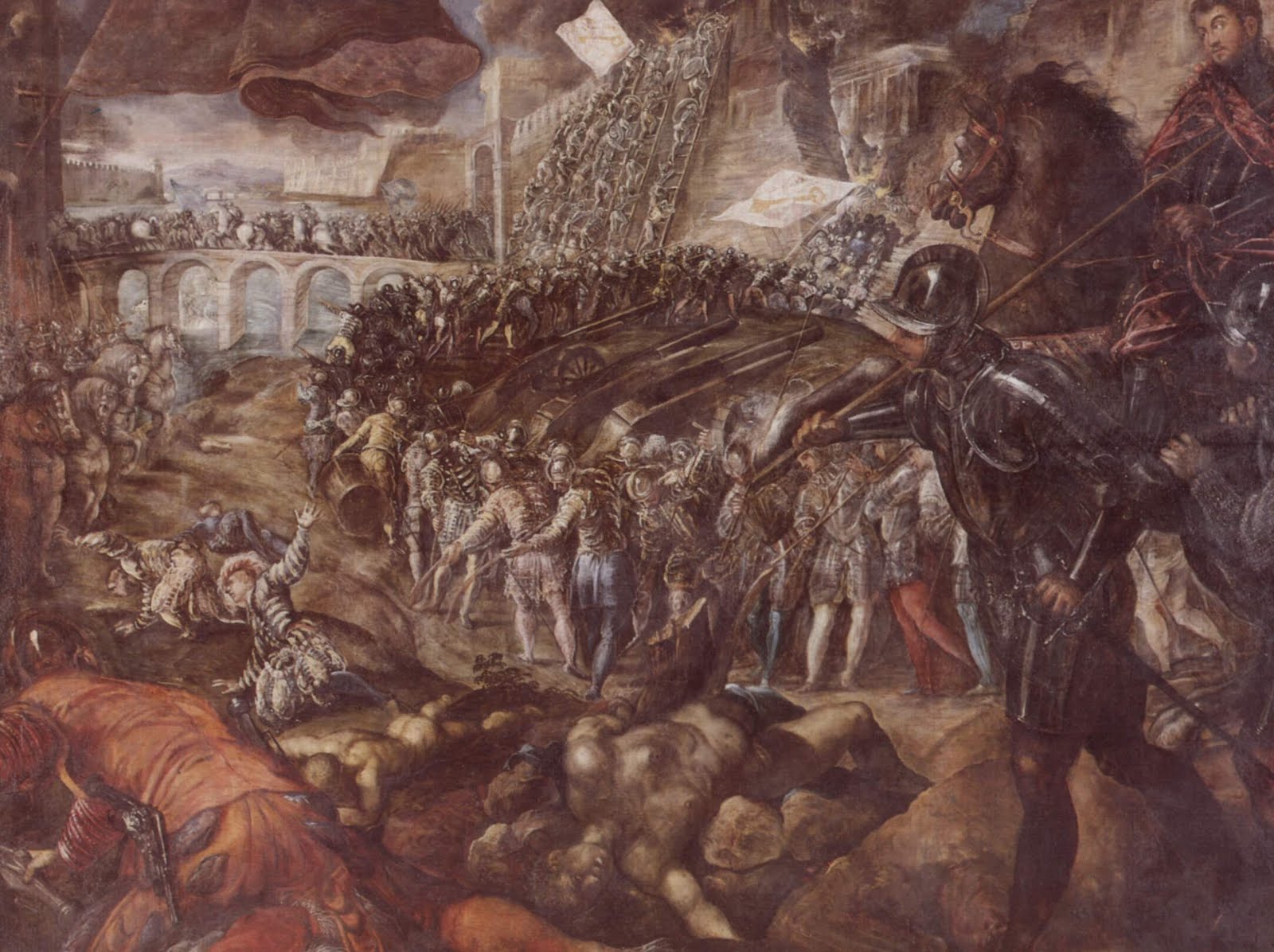
Frederick II Conquered Parma in 1521, Tintoretto (1579)
Let’s unpack this stanza-by-stanza:
Twenty men crossing a bridge,This stanza expresses quite concretely the ancient philosophical notion of the One and the Many. Each person lives in their own subjective world that cannot be shared by anyone else. Thus the march of 20 men into a village happens differently in the 20 distinct consciousness’s to the degree that it becomes 20 distinct and separate villages. By the same token, all men are one man in form and moral inheritance, we all share the mind of the one universal consciousness, much as the unified regiment of the soldiers in this image seem to be operating from one shared, hive mind.
Into a village,
Are twenty men crossing twenty bridges,
Into twenty villages,
Or one man
Crossing a single bridge into a village.
This relationship between the collective and the singular is basic to human society and to each individual’s spiritual journey, but it is fundamentally ambiguous. The collapsing figure that fragments into multiple perceptions in Cubist paintings like Duchamp's Nude Descending a Staircase cannot be easily reconciled with the Mona Lisa. Here the speaker struggles to resolve the polarity:
This is old songThe term “declare” is striking, both in its war-like implications and its connotation of a decision between two choices being definitively made. Clearly the speaker wants to know what is the ultimate truth contained in this picture. “Song” is also an interesting choice of word, suggesting an imaginative or unconscious prodding as much as an intellectual thought process. That it is old is indisputable:
That will not declare itself . . .
The One manifests as the many, the formless putting on form. (Rig Veda ~ 1200 B.C.).
We are in the habit of assuming one Form for each set of many things to which we give the same name. (Plato, The Republic, 380 BC)
Reality cannot be found except in One single source, because of the interconnection of all things with one another. (Leibniz, 1670)Interesting in this context is Fritjof Capra’s book The Tao of Physics, a wonderful introduction to the immense commonality between the Western quantum physics of the Modernist time period and ancient Eastern spiritual beliefs:
The central aim of Eastern mysticism is to experience all the phenomena in the world as manifestations of the same ultimate reality. This reality is seen as the essence of the universe, underlying and unifying the multitude of things and events we observe. The Hindus call it Brahman, The Buddhists Dharmakaya (The Body of Being) or Tathata (Suchness) and the Taoists Tao; each affirming that it transcends our intellectual concepts and defies further explanation. This ultimate essence, however, cannot be separated from its multiple manifestations. It is central to the very nature to manifest itself in myriad forms which come into being and disintegrate, transforming themselves into one another without end. (p. 210)
A careful analysis of the process of observation in atomic physics has shown that the subatomic particles have no meaning as isolated entities, but can only be understood as interconnections between the preparation of an experiment and the subsequent measurement. Quantum theory thus reveals a basic oneness of the universe. It shows that we cannot decompose the world into independently existing smallest units. As we penetrate into matter, nature does not show us any isolated ‘basic building blocks’, but rather appears as a complicated web of relations between the various parts of the whole. (p. 78)The coincident realities to the speaker of the poem seem as confounding as they must have seemed to the physicists of Stevens’ time grappling with wave-particle duality. As Capra writes:
In ordinary life, we are not aware of the unity of all things, but divide the world into separate objects and events. This division is useful and necessary to cope with our everyday environment, but it is not a fundamental feature of reality. It is an abstraction devised by our discriminating and categorising intellect. To believe that our abstract concepts of separate ‘things’ and ‘events’ are realities of nature is an illusion. (p 76).But to just accept the one as reality is to turn away from multiplicity, and more importantly to lose the promised connection of subjectivity to the unity. Einstein’s theory of invariance, his term for what we now call the theory of relativity, was designed to answer the question of why the objective laws of nature sometimes seemed to bend depending on the vantage point of the observer. Thus he developed formulas for the relationship between the constancy (or invariance) of physical laws (such as the speed of light), and the relativity of the observer (the position or motion in time or space from which it is observed). Wallace Stevens, who shared the exact same chronology as Einstein (1879-1955), is posing here how the vantage point of the observer affects the constancy of the whole, the effect of which is a reality that can’t stay fixed. How does one get beyond oneself to the ultimate reality?


Osho, who wrote the book Einstein The Buddha
The speaker tries a different tact:
Twenty men crossing a bridge,This standard-issue tautology provides a certain comfort of “that’s the way it is.” But that cannot be satisfying given what the mind had just perceived before, how it came close to a sense of ultimate reality via imagination, only to inevitably fall back on uncertainty and ambiguity.
Into a village,
Are
Twenty men crossing a bridge
Into a village.
That will not declare itselfAs with Thomas Pynchon’s novels, the patterns and correspondences the mind so easily identifies don’t connect to a truth that stays valid for more than a split second. The irrefutable truth the mind needs stands slightly beyond ever elusive. The metaphor for metaphor, I suppose, is bridge, and in this one, the narrator gets stuck on said bridge.
Yet is certain as meaning . . .
Every time the physicists asked nature a question in an atomic experiment, nature answered with a paradox, and the more they tried to clarify the situation, the sharper the paradoxes became. It took them a long time to accept the fact that these paradoxes belong to the intrinsic structure of atomic physics, and to realise that they arise whenever one attempts to describe atomic events in the traditional terms of physics. (Fritjof Capra, The Tao of Physics, p76)The traditional terms of physics are mathematics, equivalent to the words metaphysicians use. The speaker cannot give up his quest, so decides to go closer in:
The boots of the men clumpThe abstraction recedes as details come into focus: the sound of the boots on the boards, the fruit trees appearing, as they would to a soldier getting closer to the walls. This more direct engagement with the phenomenon brings a tangible sensory awareness, but one that eludes the mind and so cannot be captured or understood. The mind is left behind, as in the moment of its death trying to remember something from childhood:
On the boards of the bridge.
The first white wall of the village
Rises through fruit-trees.
Of what was it I was thinking?
So the meaning escapes.
The first white wall of the village...ChaCha! expert Randy T calls this moment in the poem “a nebulous no man’s land where the intelligence struggles, unsuccessfully, to encompass a reality beyond its reach.” The unreal can be discussed, the real cannot. Is the village even there?
The fruit-trees...
This, to Cary Wolfe (in “The Idea of Observation at Key West”, collected in What is Post-Humanism?) “[confirms] the otherness and difference of ‘external’ reality precisely by insisting on its inseparability from the mind and imagination.” The disjunction calls to mind wave/particle duality again, for the one thing (Space/Consciousness) has potentialities (Wave/Thought) that give rise to the many things (Matter as the Spherical Wave Motion of Space/Reality). Imagination is aligned with the waves in the quantum field, that seem as one and wholly different from the particles we call reality. Capra again:
At the sub-atomic level, matter does not exist with certainty at definite places, but rather shows ‘tendencies to exist’ and atomic events do not occur with certainty at definite times and in definite ways, but rather show ‘tendencies to occur.’ In the formalism of quantum theory, these tendencies are expressed as probabilities and are associated with mathematical quantities which take the form of waves. This is why particles can be waves at the same time. (p. 76)Or H.G. Widdowson, in the essay “So the Meaning Escapes…”:
[Poetry] is a reality which cannot be explained but only expressed and experienced through the expression.I think of it also as that moment when the mind gives way to direct experience. I wrote about this sensation in a poem “The Flight from Cincinnati” in terms of the way people waiting at airports for travelers stop their fretting and cogitating when they finally see the people they are there to pick up:
The people who wait look confused, then,Where does this all leave us? Despite the stretching of intellectual muscles this poem makes us do, it’s not a stretch to note that the Renaissance fighters for de Medici have been replaced by the doughboys of the Western Front, just as the science de Medici fostered was being replaced by a new science aligned with different myths.
finding their travelers, lose themselves
in recognition, the woes of the waiting
turned to song and story—then I, too,
disappear again.
The metaphors, the ability to translate and connect ideas, the highest fruits of the mind when thinking and communicating, in the end serve only the barbarism of war, with death the only resolution possible.

Or maybe that viewpoint too is relative, too narrow:
The Eastern mystics see the universe as an inseparable web, whose interconnections are dynamic and not static. The cosmic web is alive; it moves and grows and changes continually. Modern physics, too, has come to conceive of the universe as such a web of relations and, like Eastern mysticism, has recognised that this web is intrinsically dynamic. The dynamic aspect of matter arises in quantum theory as a consequence of the wave-nature of subatomic particles, and is even more essential in relativity theory, where the unification of space and time implies that the being of matter cannot be separated from its activity. The properties of subatomic particles can therefore only be understood in a dynamic context; in terms of movement, interaction and transformation. (Capra p. 78)
Friday, May 11, 2012
After All That Rain
Cauliflower clouds, in the tree boughs,
brother sun and sister earth, merged,
like this marriage of moss and stone,
the brilliance of the green
in all who live between...
Spikes of light on peaceful leaves,
the furry glare of vines, on wires
widening like cornucopias
from one line to a swarm of green,
in thicket skeins of incandescent branch
and tangled shadows, translucent grass
muscular with knee-deep seed...
New pine sprouts rest in the sun,
maple leaves shine like upside-down stars,
they drip with vibrant light,
sashay and shiver in naked delight,
their pom-poms proving they are free
as hands bow, pray, lean, arch up to see...
A motley crowd allowed to squat the beds
where spinning maple beanies aim their heads.
Algae grows on spindly spears like wands from heavy brush;
the mighty hillside pine...
The glistening is too frequent now,
too aligned
to be but in that other world
I enter, oh too briefly,
before it's gone
to radiant sun
and the twitching of my own hands.
brother sun and sister earth, merged,
like this marriage of moss and stone,
the brilliance of the green
in all who live between...
Spikes of light on peaceful leaves,
the furry glare of vines, on wires
widening like cornucopias
from one line to a swarm of green,
in thicket skeins of incandescent branch
and tangled shadows, translucent grass
muscular with knee-deep seed...
New pine sprouts rest in the sun,
maple leaves shine like upside-down stars,
they drip with vibrant light,
sashay and shiver in naked delight,
their pom-poms proving they are free
as hands bow, pray, lean, arch up to see...
A motley crowd allowed to squat the beds
where spinning maple beanies aim their heads.
Algae grows on spindly spears like wands from heavy brush;
the mighty hillside pine...
The glistening is too frequent now,
too aligned
to be but in that other world
I enter, oh too briefly,
before it's gone
to radiant sun
and the twitching of my own hands.
Thursday, May 10, 2012
Rejection
Kings will allow in what makes them look good – or giggle –
And behead anyone smarter than they are – it’s God’s will –
For life must revolve around something – we will have found
Inspiration, all of us, from the gifts of the crown,
The way he conjures heaven and the world in his mind.
But the king is just a middle-man, on either side
There are secrets, the underground and celestial
Hosts hold hands to guard the truth that’s unconditional.
The king dispenses only what’s allowed to be known,
For each must bear a silence that’s all his or her own.
Don’t look upon the sad and stupid king with pity,
For you too look away from what is not yours to see.
You too spend regret on all missed opportunities
As if you hadn’t let them go like tolls at parting seas.
And behead anyone smarter than they are – it’s God’s will –
For life must revolve around something – we will have found
Inspiration, all of us, from the gifts of the crown,
The way he conjures heaven and the world in his mind.
But the king is just a middle-man, on either side
There are secrets, the underground and celestial
Hosts hold hands to guard the truth that’s unconditional.
The king dispenses only what’s allowed to be known,
For each must bear a silence that’s all his or her own.
Don’t look upon the sad and stupid king with pity,
For you too look away from what is not yours to see.
You too spend regret on all missed opportunities
As if you hadn’t let them go like tolls at parting seas.
Wednesday, May 9, 2012
Bridge in Fog
Satan fell because he refused
to worship man (says the Koran);
what kind of servant must I be
to question my own divinity?
The ancient monoliths
so finely calibrated
to all the imperfections
of our placement in the sky
(the tilt and wobble, sidereal slant),
but still I cannot trust what is
for fear it's not quite right,
for fear I couldn't tell the difference
between what's good and what is bad
—the hardest choice to make, for where,
without that, would I ever find compassion?
to worship man (says the Koran);
what kind of servant must I be
to question my own divinity?
The ancient monoliths
so finely calibrated
to all the imperfections
of our placement in the sky
(the tilt and wobble, sidereal slant),
but still I cannot trust what is
for fear it's not quite right,
for fear I couldn't tell the difference
between what's good and what is bad
—the hardest choice to make, for where,
without that, would I ever find compassion?
Tuesday, May 8, 2012
The Oyster Bay Manifesto

This shit’s nothing new, the Knights of Malta tracked your moves like GPS a thousand years ago and read your correspondence as it went from brain to quill. They need only your resistance, nothing more, a white to frame their perfect black, a white made by DuPont the great death-dealer, that’s all you now allow yourself, when you’re chasing down the demons They created for your pleasure, that melt just as you believe you hold Them, the final Mephistopheles in your hands. An enemy! What a distraction, how the mind can be harnessed to a task: eradicate evil! What better way to penetrate the secret center and implant the seed, and with it the DNA of mechanical response – fear and longing – engineered? Divine of a kind, the way the assassins never even know who they are working for, or do not know they’re killing, and every effort to mess their noses in the scenery of their crimes only makes them feel more victimized. Thus what would be still can be projected in an arc – the mind is made to differentiate the calculus, as “proof” of fate (the gears below the gears below the gears).

A beautiful pattern, like that made by geese in winter skies, or the distant nebulas destroying all that’s there.

Any metaphors will only serve another God than the one they are attached to: the cathode-ray Jesus, the cinetheodolite Buddha. Nature is changed, but we recognize it as it was, before the spark was stolen, reflexively. All it takes to redirect the hive mind is one drone infiltrated. Once one thing is changed, universes can be reconfigured. Just one story can re-write history and make the mythic supplicant. Slowly everything becomes plausible instead of real – hallucinations ripped away from base perceptions and diseases diagnosed from the output stream of thinking – there are places that you cannot go, those now deemed too natural…

God submits to the conspiracy, plays Her part perfectly: another way to play the game of choice. If this world is seen as an illusion, there’s always a new one, better or at least more airtight. Something about accepting your own immortality. Something about peeling back the layers of distraction to accept the deeper unanswered questions: “Are you making these relentless connections, or merely seeing them?”; “What is pre-set, what do you set in motion?”; “Why the greater the resistance, the greater the temptation?” All’s you know is that the barest intimation of the ruins of Atlantis is all you need to build a house where you can live. The end of knowledge thus is falsity, innocence resolves only to complicity, the mind the unclean organ snapped like lepers’ slates. It must be kept in prison, of obsessively cancelling the x’s out on either side of the equal sign.
Prose in honor of Thomas Pynchon’s 75th birthday today…

Monday, May 7, 2012
Once Again in the Intergalactic Sweatlodge
The treasure in the hole
is there to hold
as long as it is not
defined as treasure,
a little off
the answer
when being given,
the path to home
must stay on course
despite the missed
and incorrect directions
like a memory of something new…
Temperature rising
to check the mind
awakening
the spirit with its
gentle membrane wave
proceeds…
The eyes are always crooked
adapting
to the outside
and self-created mirrors
so we can see ourselves,
while the glass which
holds my image is
a fraction of my form...
The water carries
toxins out
as water brought them in,
exchange
and in between
a breath
choosing
to receive
and when to give...
Unrecognizable endings
as the balance always settles
at a different place
in the motion,
the distant bells
remembering
what I scarcely recognize,
between the hum and the silence,
as I leap to cast my figure
moving through the space
as inside source,
a quickening
runs on forever
where my mind
so mercifully
cannot go...
Empty mind,
abundant heart –
I am born into
a towel
and at the whispered ending
released from all
but freedom’s feeling
going on, going forever on.
Saturday, May 5, 2012
Poem Composed While Asleep
The lighthouse flare
burns the hillsides,
the flowers that play
something they are not
to stand apart
to get along
must now be real
to meet the light.
burns the hillsides,
the flowers that play
something they are not
to stand apart
to get along
must now be real
to meet the light.
Thursday, May 3, 2012
Hotel Vignette
Grande Lakes, Florida
The orange lights of Orlando at dawn
as the night people with their moon-white faces
chasing billowing sun-dress breezes give way
to the people of the day, with their straight
white skirts and marble-tapping shoes
inside the luxury prison
of Romanesque colonnades,
conquistador chandeliers,
uncertain coral colors.
A squirrel runs across the palazzo
to the forest of gold bamboo.
Floating moss crosses the lake,
the sawgrass glistens.
The orange lights of Orlando at dawn
as the night people with their moon-white faces
chasing billowing sun-dress breezes give way
to the people of the day, with their straight
white skirts and marble-tapping shoes
inside the luxury prison
of Romanesque colonnades,
conquistador chandeliers,
uncertain coral colors.
A squirrel runs across the palazzo
to the forest of gold bamboo.
Floating moss crosses the lake,
the sawgrass glistens.
Wednesday, May 2, 2012
Update on a Temporary Brother-in-Law
Jacksonville Beach, FL
The curving coast
all round with sand
your orange face
behind it in some
pastel world
of crabs and divorcees,
Ward the Professor
who oversees the HVAC
and the covenants
of some sea-side
condominium community.
Your dream of making history real
is now a footnote in the journal
Pan-American Highway Notes
—not the highway that you live on
where the college students learn
how to break their parents' laws.
Once I was that college student
awed by your integrity,
your drive to make ideas come to life
through humor, hard work and humility
—the book that changes it all
may be the book that's next to read.
Everything on notecards,
not a thought that could be spared,
no frivolity on the graduate student's road.
I didn't really notice
that your heart was not quite in it,
how fear of losing everything kept you going.
How the years have set you free of that
to embrace a mess that's not
so very different from my own.
Cloudpuffs from tenured pipes
as down below I veer
to not know someone who I never could.
It was only me I guess who still believed,
you never would.
The curving coast
all round with sand
your orange face
behind it in some
pastel world
of crabs and divorcees,
Ward the Professor
who oversees the HVAC
and the covenants
of some sea-side
condominium community.
Your dream of making history real
is now a footnote in the journal
Pan-American Highway Notes
—not the highway that you live on
where the college students learn
how to break their parents' laws.
Once I was that college student
awed by your integrity,
your drive to make ideas come to life
through humor, hard work and humility
—the book that changes it all
may be the book that's next to read.
Everything on notecards,
not a thought that could be spared,
no frivolity on the graduate student's road.
I didn't really notice
that your heart was not quite in it,
how fear of losing everything kept you going.
How the years have set you free of that
to embrace a mess that's not
so very different from my own.
Cloudpuffs from tenured pipes
as down below I veer
to not know someone who I never could.
It was only me I guess who still believed,
you never would.
Tuesday, May 1, 2012
The Real Game Now
The real game now
is convincing the rich
they still have money,
and the poor that they still
lack power,
and the middle-class in the midst
of disappearing
that whatever happens
at the end of their street
everything still has
a rational explanation.
is convincing the rich
they still have money,
and the poor that they still
lack power,
and the middle-class in the midst
of disappearing
that whatever happens
at the end of their street
everything still has
a rational explanation.
M’Aider Parade
For this girl
International day of the sex worker,
The oldest and largest industry in the world,
Commoditizing for profit
The one crying, all-encompassing need,
That one will always give anything to have
And will secretly choose again and again
In those moments of torment and shame
When one finally feels alive.
Who holds the key to the means of production?
It’s time to arise like Lysistrata’s wives!
All the butterflies of programmed Monarch sex slaves;
The sexualized nine-year-olds from steroid milk and S&M cartoons;
The headless mannequins of the 24/7 sweat-shop fashion factories;
The S Factor debutantes learning high-end slut culture;
The May pole dancers trained in counterfeit intimacy;
The emaciated teenage girls in underwear on the cover of every ladies
magazine;
The surgeon-disfigured, Photoshop-altered, eating-disordered model of
earning love that is broadcast out in threatening signals to the heart
of survival at the core of every woman;
The casting-couch script doctors who turn every female character into
heroines to be fucked, victims to be saved, or dreamers after
marriageable men;
The women in China sold to their husbands' mothers, and the mothers
who own them;
The ho’s who teach the tricks to dutifully play the role of predatory boys
without mercy or restraint;
The mothers who shun reservation girls if they’re not grateful to be alive
after ultra-violent rape for the crime of drinking with the boys;
The daughters who let Indian widows flock to Vrindavan to die;
The deer-thin waifs who starve themselves for love, the acne-covering
make-up fetishists and body-piercing cutters of the soul,
all trying to fit inside a world they can never understand;
The mothers in Somalia who allow 95% of that country’s teenage girls to
have their genitals mutilated;
The underpaid executives in paralyzing heels trying to keep up with the
Jones-boys by revealing something others won’t;
The promoted secretaries who’ve been stripped of all respect by every
man, woman and hr generalist in the large, remembering building;
The Saudi wives who say not so fast on allowing women to drive or live
a portion of their lives not under a legal male guardian;
The well-spoken spokeswoman who makes it seem so kind and
reasonable to make fearful pregnant girls take a vaginal probe
after they’ve been raped by their fathers as condition for an abortion;
The kindly mother superior who says wives are required by scripture to
go back to cheating, strangling husbands who control every moment
of their lives;
The nurses in South Africa who scream at delivering mothers on their
knees to clean up their own blood;
The women who take male attention as their only means to power;
All the hard ways women learn to get a man to do what's right before
the universal judge.
Sacred prostitutes! It’s time to reclaim your body parts, your moral
center, your souls!
It’s time to stare down the male gaze, so that when the poles shift
We won't wonder why the most terrifying thing in this world was the
perfect beauty of every woman!
Unconscious the majorette raises her sceptered wand.
Unconscious we march to the beat of our wounds.
Let us pause to be conscious, to know what we do to ourselves in the
guise of others.
No parades until our sisters are respected!
No peace until the Goddess is set free!
International day of the sex worker,
The oldest and largest industry in the world,
Commoditizing for profit
The one crying, all-encompassing need,
That one will always give anything to have
And will secretly choose again and again
In those moments of torment and shame
When one finally feels alive.
Who holds the key to the means of production?
It’s time to arise like Lysistrata’s wives!
All the butterflies of programmed Monarch sex slaves;
The sexualized nine-year-olds from steroid milk and S&M cartoons;
The headless mannequins of the 24/7 sweat-shop fashion factories;
The S Factor debutantes learning high-end slut culture;
The May pole dancers trained in counterfeit intimacy;
The emaciated teenage girls in underwear on the cover of every ladies
magazine;
The surgeon-disfigured, Photoshop-altered, eating-disordered model of
earning love that is broadcast out in threatening signals to the heart
of survival at the core of every woman;
The casting-couch script doctors who turn every female character into
heroines to be fucked, victims to be saved, or dreamers after
marriageable men;
The women in China sold to their husbands' mothers, and the mothers
who own them;
The ho’s who teach the tricks to dutifully play the role of predatory boys
without mercy or restraint;
The mothers who shun reservation girls if they’re not grateful to be alive
after ultra-violent rape for the crime of drinking with the boys;
The daughters who let Indian widows flock to Vrindavan to die;
The deer-thin waifs who starve themselves for love, the acne-covering
make-up fetishists and body-piercing cutters of the soul,
all trying to fit inside a world they can never understand;
The mothers in Somalia who allow 95% of that country’s teenage girls to
have their genitals mutilated;
The underpaid executives in paralyzing heels trying to keep up with the
Jones-boys by revealing something others won’t;
The promoted secretaries who’ve been stripped of all respect by every
man, woman and hr generalist in the large, remembering building;
The Saudi wives who say not so fast on allowing women to drive or live
a portion of their lives not under a legal male guardian;
The well-spoken spokeswoman who makes it seem so kind and
reasonable to make fearful pregnant girls take a vaginal probe
after they’ve been raped by their fathers as condition for an abortion;
The kindly mother superior who says wives are required by scripture to
go back to cheating, strangling husbands who control every moment
of their lives;
The nurses in South Africa who scream at delivering mothers on their
knees to clean up their own blood;
The women who take male attention as their only means to power;
All the hard ways women learn to get a man to do what's right before
the universal judge.
Sacred prostitutes! It’s time to reclaim your body parts, your moral
center, your souls!
It’s time to stare down the male gaze, so that when the poles shift
We won't wonder why the most terrifying thing in this world was the
perfect beauty of every woman!
Unconscious the majorette raises her sceptered wand.
Unconscious we march to the beat of our wounds.
Let us pause to be conscious, to know what we do to ourselves in the
guise of others.
No parades until our sisters are respected!
No peace until the Goddess is set free!
Monday, April 30, 2012
The End of April
Firepit ash from a good burn
blows with blossoms in the gusts.
The moment is too gentle
to hold on to things that are
no longer, for the gift of life
is to grieve.
blows with blossoms in the gusts.
The moment is too gentle
to hold on to things that are
no longer, for the gift of life
is to grieve.
Sunday, April 29, 2012
The Name Book
"Somewhere deep in his shell there's an ember of pride..." - Linda Creed
In some weird way she was trying to speak to me,
like some chick-a-dee or end-of-summer cricket,
the reasons why she could no longer love me,
the things that some imagined me had done.
It came across a vast impossible chasm,
I almost heard the voice of that other me,
but it was soon drowned out by more complaining
and requests to hear her out like a gentle breeze.
I guess some honesty had broke the seal
and sent her into post-traumatic stress,
some pushing back at responsibility for her happiness
from some semblance of a self that's locked inside.
I try to, one more time, express my feelings,
and it's cancelled on procedural grounds again,
that's one of my biggest problems, she says, I never listen,
I need to hear her pain each time it comes.
Amazing how oblivious I can be
when giving love and showing vulnerability
to a closed-off heart and a shut-down mind
and irreconcilable animosity.
I hide behind her smile in public view,
and flash the thumbs-up sign to everyone.
I come home from the people I've inspired
to find an undone list of things to do
and I, perpetual fool, don't question it,
as if I need to prove my love is true,
when it's only giving someone what they want
and thinking that's exactly what I need,
to give without expectation, to love
without constraint, but it always comes again,
it's how I'm doing it, no gentleness
can soothe a charging heart full of herself.
In some weird way she was trying to speak to me,
like some chick-a-dee or end-of-summer cricket,
the reasons why she could no longer love me,
the things that some imagined me had done.
It came across a vast impossible chasm,
I almost heard the voice of that other me,
but it was soon drowned out by more complaining
and requests to hear her out like a gentle breeze.
I guess some honesty had broke the seal
and sent her into post-traumatic stress,
some pushing back at responsibility for her happiness
from some semblance of a self that's locked inside.
I try to, one more time, express my feelings,
and it's cancelled on procedural grounds again,
that's one of my biggest problems, she says, I never listen,
I need to hear her pain each time it comes.
Amazing how oblivious I can be
when giving love and showing vulnerability
to a closed-off heart and a shut-down mind
and irreconcilable animosity.
I hide behind her smile in public view,
and flash the thumbs-up sign to everyone.
I come home from the people I've inspired
to find an undone list of things to do
and I, perpetual fool, don't question it,
as if I need to prove my love is true,
when it's only giving someone what they want
and thinking that's exactly what I need,
to give without expectation, to love
without constraint, but it always comes again,
it's how I'm doing it, no gentleness
can soothe a charging heart full of herself.
Saturday, April 28, 2012
Museum Guards

They keep the art from escaping
Tapping their billy clubs
In case of a fight
Between the beautiful patrons
And the wolf-whistling art.
Big hands reach out as if to help you
But it’s only to keep you from touching
What you feel you need to touch.
They turn their lips to your ears
With reconnaissance walkie-talkies in their hands
But it’s not to explain, only to ask you to shut up.
They stand in front of curtains,
Daring you to go inside,
For you know they will monitor
Every pompous out-of-your-ass statement
Concerning the defenseless on the official walls.
You are theirs
In there.
They come in a variety of poses:
The wrestler, the backhanded priest,
The praying mantis,
And they come with a repertoire of moves:
The spear to keep you from climbing near
The computer parts covered in goo;
The wag so you won’t have to try to go up
The bare plywood stairs to nowhere;
The block to keep you from catching a glimpse
Of Leonard Peltier’s horses in snow.
Their job is to protect what they despise
And despise what they might wish to protect.
Jackson Pollock despite his size could never cut it
As one of them,
The constricting yin to the art’s freeing yang,
The enforcers of taste
For “militant nostalgia,” “palimpsestic billboards,”
“radically unpretentious epics of everyday lives and their unsated
appetites”
(Applied to poetry randomly generated out of in-box spam).
They make sure that you don’t love or hate
Anything placed so precariously in this space,
Instead to just do your time, and be whisked away
To the land promised one room beyond,
Only to find at the end their kind hands
Open at the radioactive exit sign.
Friday, April 27, 2012
Stevens Textplication 16: The Death of a Soldier

“April is the cruelest month,” TS Eliot’s “The Wasteland” famously and counter-intuitively begins, but few have connected that thought to what is the 95th anniversary this month of the U.S. entry into World War I (The Great War) and so onto the international stage of slaughter, restrictions on freedom, and monumental indebtedness. Known at the time to be a futile war over nothing in particular, it was primped up by U.S. President Wilson as a war “to keep the world safe for Democracy,” “a war to end all wars,” and it became the most bloody in world history, so bloody no one could imagine another one. The cause of the war was the 1913 establishment of the U.S. Federal Reserve Bank, which finally put the finances of the U.S. into the hands of a cartel of banks controlled by Baron Rothschild. This allowed him to act on his belief that the kings and queens he controlled in Europe had outlived their usefulness, and could be replaced with “democratic” governments that he could also (correctly, it turned out) also control. The War specifically set in motion an historic level of global indebtedness, the emergence of a Rothschild satellite the USSR, and a peace treaty dictated by Rothschild that essentially guaranteed the unthinkable, an even more bloody conflict in less than 20 years (partly led by Adolf Hitler… content censored by administrator]
The point of this quick history lesson is not to shed new light on one of the most discussed wars in history, as simply to point out that the mindset of Americans and poets was very different in 1918 when Stevens wrote “The Death of a Soldier.” Today our attitude about war can be expressed by a bumper sticker I saw today “Is there life after death? Find out if you touch my truck.” We’ve become so desensitized to the human cost of war that the shocking simplicity of Stevens’ poem—with none of the characteristic religious fervor and heroic sentiments about war that existed at that time—seems blasé. Then, however, the mass, mechanized slaughter over the dying aristocracies of Europe profoundly changed many people’s views about human nature and human progress. Stevens was not exempt from this. The first poem he published, “Phases,” in the November 1914 issue of Poetry magazine, was a response to the new soon-to-be world war, and “Death of a Soldier” came originally as the first (untitled) poem of a series called “Lettres d’un Soldat” published in 1918 in Poetry magazine. These were based on the wartime correspondence of a French painter, sergeant and devout Christian Eugene Emmanuel Lemercier, whose posthumously published letters Stevens read in 1917. Each of the poems in the series had a direct quote from Lemercier, in fact, in the front of it. For this poem (1 of the series) the epigram was “La mort du soldat est pres des choses naturelles” [the death of a soldier is an almost natural thing]. Later renamed “Death of a Soldier” without the epigram, the poem was only one of four in the series to be published in Harmonium, and the only one to be published in the Palm at the End of the Mind collection.
One wonders why Stevens cut so many of his war poems from his collections; was it mainstream sensibilities, lack of credibility in covering a subject he’d never experienced first-hand, or something deeper? Of the “Soldat” cycle Stevens wrote “the subject absorbs me, but that is no excuse: there are too many people in the world, vitally involved, to whom it is infinitely more than a thing to think of. One forgets this. I wish my all my heart that it had never occurred, even carelessly” (Letters 206). The conflation in “it” to include both the war and his poem about the war is I think an appropriate response. A poet can’t undo what war has done, only inflame the wounds.
Filled with the slow and stately rhythm one would expect in an elegy, the poem reads as follows:
Life contracts and death is expected,“Life contracts” like a balloon contracts, “and death is expected” like precipitation is expected. The matter-of-factness of the utterance clashes with the largeness of the consequences, highlighting the insanity of believing that the human folly of war-making is a natural contraction of life’s growth and abundance, and of factoring in a young man’s death as a reasonable and normal result. Human war becomes its own inhuman season, where the soldier is no more than a falling leaf.
As in a season of autumn.
The soldier falls.
He does not become a three-days’ personage,
Imposing his separation,
Calling for pomp.
Death is absolute and without memorial,
As in a season of autumn,
When the wind stops.
When the wind stops and, over the heavens,
The clouds go, nevertheless,
In their direction.
Lemercier’s soldier of Christ does not get it easy like Christ, resurrected after “three days” and given a annual commemoration of pomp as a reminder how He is separate from humanity, more divine than the rest of us.
The soldier’s death by contrast is “absolute and without memorial.” Despite the plaque in every town and the private wreaths in graveyards, the one who makes the ultimate sacrifice is in fact what most people want to forget after the war, in favor of compensatory causes and spoils. The soldier in that inhuman season is no different than a temporary wind that has stopped blowing.
This analogy is repeated, the movement of clouds across the heavens added, a poetic touch of moving in heaven although life on earth has been stilled. This suggestion of immortality is made less certain by the clouds going “over” the heavens (as the sky is seen from the observer on earth), and by the ambiguous clouds moving in “their” (heaven’s) direction. We are looking at death from the ground, stripped of the patriotic, religious and rhetorical devices that make it seem, as in so many poets before the Great War, lofty and purposeful. There is nothing in this version of war but meaningless death.
A surprisingly gentle anti-war sentiment.
Hart Crane
Eighty years ago this morning Harold Hart Crane fell to his death from a cruise ship deck, age 32. He left behind some of the most beautiful poems ever written by an American...
For the Marriage of Faustus and Helen
For the Marriage of Faustus and Helen
Thursday, April 26, 2012
More Ascension Symptoms
The only distinction between God and us
Is that God sees Itself in every one.
Such infinite self-worth
in the infinite self,
but all portions of the prism
deserve the recognition
of their sublime ambition,
their relentless spin toward perfection.
The wholeness of the ocean
swims inside my fingers
still I dare to tell the others
how to sing their soul song?
Why should this microcosm
believe in other realms?
My mind is nothing but a crystal,
makes vibrations into shapes,
for love’s harmonic resonance
the reason it creates.
Is that God sees Itself in every one.
Such infinite self-worth
in the infinite self,
but all portions of the prism
deserve the recognition
of their sublime ambition,
their relentless spin toward perfection.
The wholeness of the ocean
swims inside my fingers
still I dare to tell the others
how to sing their soul song?
Why should this microcosm
believe in other realms?
My mind is nothing but a crystal,
makes vibrations into shapes,
for love’s harmonic resonance
the reason it creates.
Wednesday, April 25, 2012
A New Leaf
A flag at half mast
I failed
for the battle was a proxy for the one inside my head
I can't resolve
some flailing out at some deep past injustice
I long ago surrendered to...
So much easier to look in the light
with its wasted lives and starving people
than the shadow where the truth lies
not yet melted of its frost
while nearby dogwoods blossom
without fragrance merely a moment's opening
to endlessness
waiting with infinite patience
I failed
for the battle was a proxy for the one inside my head
I can't resolve
some flailing out at some deep past injustice
I long ago surrendered to...
So much easier to look in the light
with its wasted lives and starving people
than the shadow where the truth lies
not yet melted of its frost
while nearby dogwoods blossom
without fragrance merely a moment's opening
to endlessness
waiting with infinite patience
Tuesday, April 24, 2012
Another Vivid Dream
I remember the competition
over fishing holes in Georgia,
Illinois, Northeast Montana,
and how we traded barbs
with shots of Old Granddad
in that dusty French museum of an HQ,
so noble in our plans,
bequeathing hot dogs and paper
napkins on the conquered,
thinking some day we may take on
those rows of gold-dipped books.
We'd been polished like brass
for weeks by squadron leaders,
feted as the victors; they never
had to ask for our permission.
We volunteered
for any mission.
We argued over maps
but shared our chewing gum.
We thought how bad it was
our desert target was infested
with all those poison-armed arachnids.
We guarded each perquisite
of our respective roles
—pilot, gunner, navigator—
like the detail for an emperor.
Our precision was our silence,
for there always comes a time
when the arguing must end.
I remember all of that
as if it happened yesterday,
the smell of sulphur triggers,
the sound of raining sand,
but the thought that there were people
below our cookie bomb
has never once occured
in all these years.
over fishing holes in Georgia,
Illinois, Northeast Montana,
and how we traded barbs
with shots of Old Granddad
in that dusty French museum of an HQ,
so noble in our plans,
bequeathing hot dogs and paper
napkins on the conquered,
thinking some day we may take on
those rows of gold-dipped books.
We'd been polished like brass
for weeks by squadron leaders,
feted as the victors; they never
had to ask for our permission.
We volunteered
for any mission.
We argued over maps
but shared our chewing gum.
We thought how bad it was
our desert target was infested
with all those poison-armed arachnids.
We guarded each perquisite
of our respective roles
—pilot, gunner, navigator—
like the detail for an emperor.
Our precision was our silence,
for there always comes a time
when the arguing must end.
I remember all of that
as if it happened yesterday,
the smell of sulphur triggers,
the sound of raining sand,
but the thought that there were people
below our cookie bomb
has never once occured
in all these years.
Monday, April 23, 2012
The Conflicted Self Finds Peace at a Mirage
Azaleas in the graveyard;
The warrior’s work is never done;
Always new creation.
Creators blessed as well
By seeing all they formed from air
Destroyed.
Still, one must hold on to something.
Is it natural
Playing Spring
And Fall
As pairs?
We fill the shapes too easily
Because we can’t fit into them
At all.
The warrior’s work is never done;
Always new creation.
Creators blessed as well
By seeing all they formed from air
Destroyed.
Still, one must hold on to something.
Is it natural
Playing Spring
And Fall
As pairs?
We fill the shapes too easily
Because we can’t fit into them
At all.
Sunday, April 22, 2012
Thoughts Drowned Out by Rain
The only people
ever right
are those who can stay silent
for there is only war
when words are used
in place of truth
there may not be a wound,
it may feel even preferable
most of the time for most of the world
but still its only people
fighting their own
ugly selves
instead of listening for their private star
or testing how deep their awareness can go
or learning ways to show they really know how to love.
Still, that lunar face
with all its loving kindness
we call silence
seems to beckon
always
a response
some thought to bridge the distance,
to know the space is shared,
simpatico appreciated,
the calling of one's outline in the light
to say "I am your gift"
in pure surrender
when the gifts are harmonized already,
the extra word that hurts the night
is that first word.
ever right
are those who can stay silent
for there is only war
when words are used
in place of truth
there may not be a wound,
it may feel even preferable
most of the time for most of the world
but still its only people
fighting their own
ugly selves
instead of listening for their private star
or testing how deep their awareness can go
or learning ways to show they really know how to love.
Still, that lunar face
with all its loving kindness
we call silence
seems to beckon
always
a response
some thought to bridge the distance,
to know the space is shared,
simpatico appreciated,
the calling of one's outline in the light
to say "I am your gift"
in pure surrender
when the gifts are harmonized already,
the extra word that hurts the night
is that first word.
Saturday, April 21, 2012
Saturday Night Poetry Reading
It was two years ago I was relocated to New York City. For the first month I lived in corporate housing, the 777 building where Chelsea, Midtown and the Garment District meet, the old Tin Pan Alley. The poems I did in that month were limited to seven lines, seven beats per line (most of the time), seven days a week. Tonight I'll read the whole sequence, with the help of Archie Shepp, Carmen Bradford, Joe Henderson, John Coltrane and a cast of millions. It's a bit long but it captures in newness the stretch of the place they call The City...
Sorry about the p's...The originals can be found at the following links:
April 5-30, 2010
May 1-4, 2010
Sorry about the p's...The originals can be found at the following links:
April 5-30, 2010
May 1-4, 2010
Friday, April 20, 2012
In Duck with Maddy and Dean
That weekend at the beach
when I bought a couple cartons of Winstons,
shared an eight-ball between us,
read William S. Burroughs' Junky
and heard "Free Falling" over 150 times.
when I bought a couple cartons of Winstons,
shared an eight-ball between us,
read William S. Burroughs' Junky
and heard "Free Falling" over 150 times.
Thursday, April 19, 2012
Wednesday, April 18, 2012
Blueprint
The clean room,
all the lines like floor plan drawings:
the hallways lead to doors forever open,
the furniture is symbols,
light is now circumference,
the people theoretical,
the toilets, sinks and stairs
the only things remotely real...
It's perfect as a player piano roll.
We call it home,
but only 'cos it ends just like a razor edge
with nothing past the white but total darkness,
the only thing we care about,
the place that we can't go.
all the lines like floor plan drawings:
the hallways lead to doors forever open,
the furniture is symbols,
light is now circumference,
the people theoretical,
the toilets, sinks and stairs
the only things remotely real...
It's perfect as a player piano roll.
We call it home,
but only 'cos it ends just like a razor edge
with nothing past the white but total darkness,
the only thing we care about,
the place that we can't go.
Patrick's Revenge
There is no other person
to save me from my frame
just terse misunderstanding
and the hunger to be right.
Friends are to be ignored,
jeered and spat upon,
and people you don't even know
turned into heroes,
for feelings are not relevant,
and thoughts should not be clear
and spirit is a hammer when you lack it.
I did not need to be listened to,
although I listened hard,
I did not need response of any kind,
though I responded kindly and in kind
at every opportunity for love.
I held back what I knew
from ears too sensitive for truth,
and breathed three times
when lies were freshly planted
for that is how it often is
with children, 'cos I knew
there was agreement in the richnesses
of words, the generosity of the soil -
not you, you bitter parasite,
it was not for you I made you great,
that I answered half-formed cries,
but because you had such dire need of faith
and I had some to give - it seemed
a fair exchange, at the time,
that you might, if not reciprocate,
at least allow for truth,
in the hope that one day you might
track it down, with reporter's hat
and detective's cape, in some dusty
library at the end of the world -
but life cracks even through those stacks,
projects a shameful monster shadow
over every word you read
til the world becomes so narrow
so full of threat and evil,
that you can only criticize
whatever aspect of yourself you can find
in books, the only real life you have left.
I'd say goodbye, but I'm not really sure
if hello was not all in my mind from the first,
and the truth and beauty recognized
was only ever all my own.
I wanted to believe each day
in a shaped world of apt quotation,
but it only was me finding it
in the end, despite it all
and finally the contradiction
could no longer be hidden...
what works for you, without exclusion,
excludes the rest of us without exception.
to save me from my frame
just terse misunderstanding
and the hunger to be right.
Friends are to be ignored,
jeered and spat upon,
and people you don't even know
turned into heroes,
for feelings are not relevant,
and thoughts should not be clear
and spirit is a hammer when you lack it.
I did not need to be listened to,
although I listened hard,
I did not need response of any kind,
though I responded kindly and in kind
at every opportunity for love.
I held back what I knew
from ears too sensitive for truth,
and breathed three times
when lies were freshly planted
for that is how it often is
with children, 'cos I knew
there was agreement in the richnesses
of words, the generosity of the soil -
not you, you bitter parasite,
it was not for you I made you great,
that I answered half-formed cries,
but because you had such dire need of faith
and I had some to give - it seemed
a fair exchange, at the time,
that you might, if not reciprocate,
at least allow for truth,
in the hope that one day you might
track it down, with reporter's hat
and detective's cape, in some dusty
library at the end of the world -
but life cracks even through those stacks,
projects a shameful monster shadow
over every word you read
til the world becomes so narrow
so full of threat and evil,
that you can only criticize
whatever aspect of yourself you can find
in books, the only real life you have left.
I'd say goodbye, but I'm not really sure
if hello was not all in my mind from the first,
and the truth and beauty recognized
was only ever all my own.
I wanted to believe each day
in a shaped world of apt quotation,
but it only was me finding it
in the end, despite it all
and finally the contradiction
could no longer be hidden...
what works for you, without exclusion,
excludes the rest of us without exception.
Tuesday, April 17, 2012
Subscribe to:
Posts (Atom)